For many organizations, asbestos is viewed as a legacy issue that was resolved decades ago. Australia prohibited the manufacture, import and use of asbestos-containing materials (ACMs) from 31 December 2003, yet a significant proportion of commercial, industrial and public infrastructure constructed before this date continues to contain asbestos in some form.
The challenge is not simply the presence of asbestos within a building. In many cases, asbestos-containing materials remain stable and present little immediate risk while left undisturbed. The greater risk arises when maintenance activities, refurbishment projects, service upgrades or demolition works disturb these materials, creating the potential for airborne fiber release and occupational exposure.
This is where Division 5 Asbestos Audits become an essential component of workplace risk management.
Rather than treating asbestos as an isolated compliance issue, organizations should consider it within the broader context of asset management, occupational hygiene and environmental risk. A well-executed Division 5 audit provides the information required to safely manage asbestos-containing materials throughout the operational life of a building, supporting informed decision-making while protecting workers, contractors and building occupants.
Why Asbestos Remains a Workplace Risk
Although asbestos use ceased more than twenty years ago, many Australian workplaces continue to operate within buildings constructed during the decades when asbestos products were extensively used.
These materials were incorporated into a wide range of building components because of their durability, thermal stability and fire-resistant properties. As a result, asbestos may still be present within:
- External cladding and wall sheeting
- Roofing materials
- Eaves and soffits
- Electrical switchboards
- Vinyl flooring and backing materials
- Pipe lagging and insulation
- Cement sheeting
- Plant rooms and service penetrations
Many of these materials remain concealed behind finishes or within service cavities. Others may only become apparent during refurbishment, maintenance or infrastructure upgrades.
From an occupational hygiene perspective, asbestos becomes a risk when fibres are released into the breathing zone. Activities such as drilling, cutting, demolition, cable installation, mechanical servicing or even routine maintenance can inadvertently disturb asbestos-containing materials if they have not been previously identified and documented. This makes asbestos management fundamentally different from many other workplace hazards. The risk is often latent until building works commence.
Understanding the Duty to Manage Asbestos
Australian work health and safety legislation places clear responsibilities on the person with management or control of a workplace to identify and manage asbestos risks. For commercial buildings and workplaces constructed before the national asbestos prohibition, this extends beyond simply knowing asbestos may exist. Duty holders are expected to:
- Identify asbestos-containing materials, or presume their presence where confirmation is not reasonably practicable.
- Maintain an accurate and current asbestos register.
- Review asbestos information when circumstances change.
- Ensure workers, contractors and other relevant parties have access to asbestos information before undertaking work.
- Implement appropriate management measures to prevent exposure.
Importantly, these obligations are ongoing. They are not satisfied by completing a single inspection many years earlier. As buildings age, undergo modifications or change ownership, asbestos information must continue to reflect actual site conditions. Failure to maintain accurate records can significantly increase occupational exposure risks during maintenance or refurbishment activities.
Division 5 Audits Are About Risk Management—Not Simply Compliance
One of the most common misconceptions surrounding Division 5 audits is that they exist purely to satisfy legislative requirements. In practice, their value extends much further.
A professionally undertaken Division 5 audit establishes the information required to make informed decisions about building management throughout its operational life. Rather than asking only, “Does this building contain asbestos?”, a Division 5 audit seeks to answer broader questions, including:
- Where are asbestos-containing materials located?
- What type of asbestos-containing materials are present?
- What is their current condition?
- What is the likelihood of disturbance during normal building operations?
- Which materials present the greatest exposure risk?
- What management controls should be implemented?
Answering these questions enables organizations to proactively manage risk before maintenance activities create uncontrolled exposure pathways. From an asset management perspective, the audit becomes a practical decision-making tool rather than a regulatory document that sits on a shelf.
Why Early Identification Supports Better Project Outcomes
One of the greatest contributors to project delays is the unexpected discovery of asbestos after maintenance or refurbishment works have commenced. When asbestos is identified late, organizations often face:
- Immediate work stoppages
- Unplanned project redesign
- Additional consultant and contractor mobilization
- Delays to construction programs
- Increased project costs
- Regulatory reporting requirements
- Increased occupational exposure risks
Early identification allows asbestos management strategies to be incorporated into project planning before physical works begin. This is particularly important for organizations responsible for complex asset portfolios, including:
- Local government facilities
- Schools and universities
- Healthcare facilities
- Manufacturing plants
- Warehouses
- Utilities infrastructure
- Commercial office buildings
- Shopping centres
- Transport infrastructure
Within these environments, maintenance activities occur continuously. Having an accurate understanding of asbestos risks enables maintenance teams, contractors and project managers to work safely while avoiding unnecessary disruption.
Environmental Consultants Play a Broader Role
While asbestos removal is undertaken by licensed removal contractors, the role of an environmental consultant is fundamentally different. Occupational hygienists and environmental consultants provide independent technical advice before, during and after asbestos-related works. This may include:
- Identifying asbestos-containing materials through systematic inspection.
- Developing asbestos registers and management documentation.
- Coordinating representative sampling programs.
- Interpreting laboratory results.
- Assessing occupational exposure risks.
- Advising on appropriate control measures.
- Supporting refurbishment and demolition planning.
- Undertaking clearance inspections and asbestos air monitoring where required.
By separating risk assessment from removal activities, organizations receive independent advice that supports informed decision-making throughout the lifecycle of their assets.
For building owners, facility managers and project teams, this independent advisory role provides confidence that asbestos risks are being managed using sound occupational hygiene principles rather than reactive responses once works have already commenced.
What Does a Division 5 Asbestos Audit Involve?
A Division 5 Asbestos Audit is a structured assessment undertaken to identify, assess and document asbestos-containing materials (ACMs) within an operational building or workplace. Unlike a pre-demolition survey, the objective is not to locate every possible asbestos product hidden within the building fabric. Instead, the audit establishes a practical framework for managing asbestos safely during the normal operation, maintenance and occupation of the facility.
An effective audit combines building knowledge, occupational hygiene principles, material assessment and laboratory verification to produce information that can be relied upon by asset managers, contractors and maintenance personnel. While every property presents different challenges, a comprehensive Division 5 audit generally includes the following components.
Desktop Review & Site Familiarisation
Before entering the field, existing information should be reviewed wherever possible.
This may include:
- Previous asbestos registers
- Historical building plans
- Refurbishment records
- Maintenance documentation
- Previous laboratory reports
- Historical aerial imagery or development records
Understanding the evolution of a building often assists in identifying areas where asbestos-containing materials are likely to remain or where previous works may have altered original construction. For larger facilities, this preliminary review also assists in planning the inspection methodology and identifying operational constraints before the site visit.
Systematic Building Inspection
Rather than simply walking through the building, experienced occupational hygienists undertake a systematic inspection of accessible internal and external areas, considering both the original construction methods and subsequent modifications. Particular attention is typically given to:
- Building envelopes
- Roofing systems
- Wall and ceiling linings
- Service penetrations
- Mechanical plant rooms
- Electrical infrastructure
- Wet areas
- External structures
- Plant and equipment
The inspection also considers the condition of suspected materials, evidence of previous disturbance, accessibility and the likelihood that future maintenance activities could affect the material. This process requires considerably more than recognising common asbestos products. It requires an understanding of building construction, deterioration mechanisms and potential exposure pathways.
Representative Sampling & Material Identification
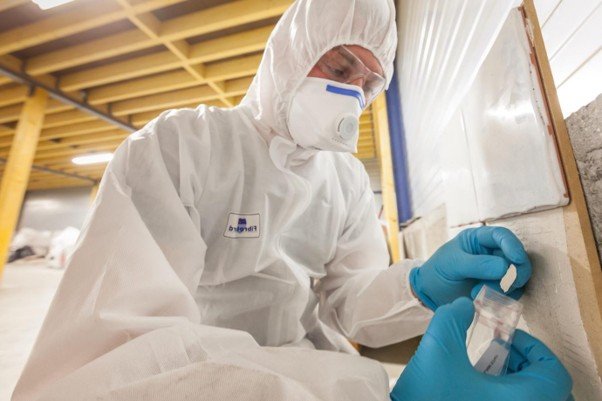
Visual inspection alone cannot reliably confirm whether a material contains asbestos.
Many non-asbestos products closely resemble asbestos cement sheeting, vinyl products or insulation materials. Conversely, materials that appear benign may contain asbestos fibres that are not visible to the naked eye.
Where appropriate, representative samples are carefully collected using controlled procedures designed to minimise fibre release. Sampling strategies are developed to ensure:
- Representative material selection
- Minimal disturbance
- Appropriate contamination controls
- Accurate sample identification
- Complete chain-of-custody documentation
The objective is not to collect the greatest number of samples, but to obtain sufficient evidence to confidently characterise each material type throughout the building.
Representative sampling also reduces unnecessary laboratory costs while maintaining technical confidence in the final assessment.
Why NATA-Accredited Laboratory Analysis Matters
Laboratory analysis is one of the most critical components of any asbestos audit.
Accurate identification of asbestos fibres requires specialised analytical techniques performed under robust quality assurance procedures. Incorrect identification can have significant consequences, either exposing workers to unmanaged risks or resulting in unnecessary remediation costs.
Samples collected during a Division 5 audit should therefore be analysed by a NATA accredited laboratory operating in accordance with recognised analytical standards.
Laboratory analysis commonly utilises Polarised Light Microscopy (PLM) to determine:
- Whether asbestos fibres are present
- The asbestos fibre type
- Material composition
- Confidence in analytical findings
Accreditation provides confidence that analytical procedures, equipment calibration, staff competency and quality assurance processes are independently verified. For building owners and project teams, this provides defensible evidence should future maintenance, refurbishment or regulatory enquiries arise.
Assessing Risk Rather Than Simply Recording Materials
Identifying asbestos is only one component of the audit. A professionally prepared Division 5 assessment also evaluates the relative risk posed by each asbestos-containing material.
This assessment considers factors including:
- Material condition
- Friability
- Surface damage
- Accessibility
- Occupancy patterns
- Maintenance frequency
- Potential disturbance
- Exposure likelihood
For example, asbestos cement sheeting in good condition located within a secured plant room may present a significantly lower immediate risk than damaged insulation board within a frequently accessed service corridor. Understanding these differences allows resources to be directed towards higher-risk materials rather than applying the same management approach across an entire building.
Developing an Effective Asbestos Register
The asbestos register is often viewed as the final deliverable of a Division 5 audit. In reality, it should be considered a living operational document. A well-prepared asbestos register enables organisations to make informed decisions whenever maintenance, refurbishment or contractor access is required. An effective register should include:
- Material description
- Precise location
- Laboratory identification results
- Material condition
- Risk assessment
- Photographic records
- Recommended management actions
The register should be sufficiently detailed that maintenance personnel unfamiliar with the building can confidently identify asbestos-containing materials before commencing work.
The objective is practical risk communication—not simply regulatory compliance.
Division 5 vs Division 6 Asbestos Audits
Although the two audit types are frequently confused, they serve very different purposes.
| Division 5 Audit | Division 6 Audit |
| Supports ongoing management of asbestos during normal building occupation | Supports demolition or refurbishment activities where building fabric will be disturbed |
| Generally non-destructive
|
Intrusive and destructive where required |
| Focuses on accessible materials | Investigates concealed spaces and inaccessible construction elements |
| Produces an asbestos register and management recommendations | Identifies all asbestos requiring removal before demolition or refurbishment |
| Appropriate for operational workplaces | Required before major demolition or refurbishment works |
Selecting the correct audit is critical. Undertaking a Division 5 audit before major refurbishment will rarely provide sufficient information for demolition planning, while performing a Division 6 audit on an operational workplace may introduce unnecessary disruption. Understanding the intended scope of future works should always determine the appropriate investigation methodology.
Common Compliance Gaps We Encounter
Many organisations believe they have effectively managed asbestos because an asbestos register exists. In practice, documentation alone does not necessarily demonstrate effective risk management. Some of the more common issues encountered during reviews include:
Registers That Have Not Been Updated
Buildings evolve over time. Maintenance works, refurbishments and service upgrades frequently alter building fabric. Registers that are many years old often no longer reflect actual site conditions.
Incomplete Material Identification
Historical surveys occasionally omitted inaccessible areas, external structures, or later building additions. As a result, contractors may unknowingly disturb asbestos-containing materials that were never included within the register.
Limited Communication With Contractors
One of the most significant exposure risks occurs when contractors commence work without reviewing the asbestos register. Maintenance personnel, electricians, plumbers and mechanical contractors should understand asbestos risks before undertaking work—not after materials have been disturbed.
Treating Compliance as a Once-Off Exercise
Perhaps the most common misconception is that a Division 5 audit is completed once and never revisited. Effective asbestos management requires ongoing review whenever:
- Building alterations occur
- ACMs deteriorate
- New information becomes available
- Maintenance activities expose previously concealed materials
- Regulatory expectations change
An asbestos register should therefore be viewed as an active component of workplace risk management rather than an archived compliance document.
Where Division 5 Audits Deliver the Greatest Value
Although asbestos management is often associated with older industrial facilities, the need for Division 5 audits extends across a broad range of commercial and public-sector assets. Any workplace constructed before the national asbestos ban should be assessed to determine whether asbestos-containing materials are present and how they should be managed.
Local Government & Community Infrastructure
Councils are responsible for diverse property portfolios that often include offices, depots, sporting pavilions, libraries, community centres and public amenities. Many of these facilities have undergone multiple renovations over several decades, increasing the likelihood that asbestos-containing materials remain concealed within the building fabric. A current asbestos register assists councils in planning maintenance programs, engaging contractors safely and meeting their obligations as the person with management or control of a workplace.
Education Facilities
Schools, universities and training facilities present unique challenges because maintenance activities frequently occur while buildings remain occupied.
Division 5 audits help education providers understand where asbestos-containing materials are located so routine maintenance, technology upgrades and future refurbishment works can proceed without creating unnecessary exposure risks for staff, students or contractors.
Healthcare & Aged Care Facilities
Hospitals, medical centres and aged care facilities often operate continuously, making intrusive investigations difficult. A structured asbestos management program allows building owners to coordinate maintenance and refurbishment works while maintaining operational continuity and protecting patients, visitors and healthcare workers.
Industrial & Manufacturing Sites
Manufacturing facilities commonly contain asbestos within plant rooms, process infrastructure, electrical installations and service buildings. These environments also experience frequent maintenance shutdowns and equipment replacement programs, making accurate asbestos information essential for planning works safely and minimising production downtime.
Why Organizations Engage Occupational Hygiene Consultants
Managing asbestos risk requires more than identifying suspect materials. It involves understanding how those materials interact with workplace activities, maintenance programs and future redevelopment plans. Occupational hygienists apply recognised exposure assessment principles to evaluate how asbestos-containing materials may affect workers, contractors and building occupants over time.
Professional environmental consultancy services provide independent technical advice throughout this process, including:
- Division 5 asbestos audits
- Asbestos risk assessments
- Representative material sampling
- Coordination of NATA-accredited laboratory analysis
- Development and review of asbestos registers
- Asbestos management plans
- Air quality monitoring where required
- Refurbishment and demolition planning advice
- Clearance inspections and verification services
This independence enables recommendations to remain objective and based solely on occupational hygiene principles, regulatory requirements and the specific risks presented by each site.
For asset owners and project managers, separating risk assessment from remediation action plans provides greater confidence that management decisions are technically robust, proportionate and aligned with legislative obligations.
Frequently Asked Questions
Does every commercial building require a Division 5 asbestos audit?
Not necessarily. However, if a workplace was constructed before 31 December 2003 and asbestos has not been conclusively ruled out, an audit is generally the most reliable way to identify asbestos-containing materials and establish appropriate management measures.
How often should a Division 5 asbestos audit be reviewed?
There is no fixed review interval that applies to every building. Reviews should occur whenever there are significant changes to the building, maintenance activities that may affect asbestos-containing materials, changes in occupancy, deterioration of known materials or where existing asbestos information is no longer considered accurate.
Can asbestos remain in a building?
Yes. In many circumstances, asbestos-containing materials in good condition can remain safely in place provided they are appropriately identified, recorded and managed. Removal is not always the preferred or most practical risk management option.
Is laboratory testing always required?
Where the presence of asbestos cannot be confirmed through existing documentation or reliable historical information, representative sampling and laboratory analysis provide the most defensible basis for material identification.
What happens if asbestos is identified?
The appropriate response depends on the material type, condition, accessibility and likelihood of disturbance.
Management options may include:
- Ongoing monitoring
- Labelling
- Encapsulation or sealing
- Restricted access
- Planned removal during future refurbishment
- Immediate remediation where materials present an unacceptable exposure risk
Each option should be determined through a structured risk assessment rather than applying a single approach across all asbestos-containing materials.
Building Confidence Through Proactive Asbestos Management
The most effective asbestos management programs begin long before refurbishment or demolition works are contemplated.
By understanding where asbestos-containing materials are located, how they may be disturbed and what controls are required, organizations can integrate asbestos risk management into routine asset maintenance rather than responding only when issues arise.
For commercial property owners, facility managers, local government authorities and infrastructure operators, a Division 5 Asbestos Audit provides more than regulatory compliance. It delivers the information needed to support safe maintenance practices, informed capital planning and responsible management of ageing building assets.
Look for Occupational Hygiene Services that combine occupational hygiene expertise with practical environmental consulting to help organizations understand and manage asbestos risks throughout the lifecycle of their assets. From initial investigations through to ongoing management advice, we work with clients to develop practical, evidence-based solutions that protect people, support compliance and reduce long-term operational risk.
